уторак, 24. јул 2012.

Kanji

In parallel to the Hiragana and Katakana writing systems, Kanji is the third writing system of the Japanese language and is by far the most complicated. The word "Kanji" literally means "Chinese character", simply because Japanese people started using the Chinese writing system many centuries ago.

Here are a few examples of Kanji:

Kanji Meaning 友 friendship 山 mountain 梨 pear

Kanji are ideograms. This means that beyond a simple audio and graphic representation, they each convey one or more meanings. The Roman alphabet by itself has no meaning unless you use it to create words, whereas in Japanese, each Kanji always has its own meaning.

It is also important to notice that Kanji cannot be used without Hiragana and Katakana in a sentence. When learning the language you will see that the verb forms are always written in Hiragana, and most foreign words are written in Katakana. And quite often, the name of cities that are generally written in Kanji will also be shown in Hiragana on flyers, billboards, etc. The 3 writing systems are used in parallel in written Japanese, and the choice of using one instead of the other for a word is set by usage conventions or for stylistic reasons.

In fact, the more Kanji you know, the easier it gets. Why? Because Kanji are composed of one graphical element or more that will also be used in other Kanji. There are thousands of Kanji, but there are only 214 elements that compose them. With these 214 elements we are able to draw every Kanji.

The following example shows how the Kanji for « bark » is constructed from two elements that belong to the list of 214 radicals.

mouth +dog =to bark ---> 口 +犬= 吠

Among the elements that compose a Kanji character, one is more important than the others. This is called the radical. It is that part that often carries the main meaning of the character. Knowing that radical often makes it easier to memorize a Kanji.

雪 This character means SNOW and its radical is 雨 which means RAIN

Reading Kanji Although Kanji originated from China, the way you read Japanese Kanji and Chinese Kanji is different since there are different ways to pronounce a Japanese Kanji. It is the word in which the Kanji is included and the context in which it is used that indicates the correct way to read each Kanji. It is complicated: that’s why it is more interesting to learn Kanji when found in a word instead of learning Kanji on their own. In Japanese, there are two main types of reading for Kanji: the ON reading, which is the Chinese pronunciation, and the KUN reading, which is the Japanese pronunciation. You will need to know when to use one or the other. Once again, if you learn the Kanji when you encounter them within a word, you will not have to worry about that. It is undoubtedly more efficient to know a lot of words without knowing each and every pronunciation for the kanji used in it, rather than mastering all the possible ways to read a Kanji character without knowing a word that uses it. Writing Kanji You cannot simply write Kanji any way you want. Fortunately, respecting the stroke order is not that hard since there are rules on that matter, and these rules really make the learning process easier. Furthermore, the rules concerning the strokes will be well assimilated once you have learned a hundred Kanji or so, and they become almost natural. Ultimately, that constraint is not really a constraint and greatly helps to memorize the Kanji. In fact, writing a character the same way every time rather than drawing Kanji on the spur of the moment will let you quickly acquire automatic reflexes when it comes to writing Kanji In addition, these rules help define the count of strokes used in writing a character. In most dictionaries a character can be found according to the number of strokes used to write it, so being able to count the number of strokes is important, even if it's only for the sake of looking up a Kanji character in a dictionary. By mastering the 214 radicals, you will know the number of strokes used in a Kanji very easily. But, if you do not master the radicals, practice with writing Kanji and experience will let you acquire this skill quickly too.
петак, 15. јун 2012.

Katakana (Japanese second leter of three)


Japanese Katakana

Origin

The katakana syllabary was derived from abbreviated Chinese characters used by Buddhist monks to indicate the correct pronunciations of Chinese texts in the 9th century. At first there were many different symbols to represent one syllable of spoken Japanese, but over the years the system was streamlined. By the 14th century, there was a more or less one-to-one correspondence between spoken and written syllables.
The word katakana "part (of kanji) syllabic script". The "part" refers to the fact that katakana characters represent parts of kanji.

Characteristics and usage of katakana

The katakana syllabary consists of 48 syllables and was originally considered "men's writing". Since the 20th century, katakana have been used mainly to write non-Chinese loan words, onomatopoeic words, foreign names, in telegrams and for emphasis (the equivalent of bold, italic or upper case text in English). Before the 20th century all foreign loanwords were written with kanji.
Katakana are also used to write Ainu, a language spoken on the northern Japanese island of Hokkaido.

Katakana and the kanji from which they developed

In each column the rōmaji appears on the left, the katakana symbols in the middle and the kanji from which the symbols were derived on the right.
katakana syllabary and the Chinese characters from which the syllables are derived
The symbols for 'wi' and 'we' were made obsolete by the Japanese Minsitry of Education in 1946 as part of its language reforms.

Katakana syllabary (片仮名 / カタカナ)

The symbols on the right are the basic katakana syllabary in the order they appear in dictionaries and indices (reading from left to right and top to bottom). Additional sounds (the symbols on the right) are represented by diacritics and combinations of symbols.
Katakana syllabary

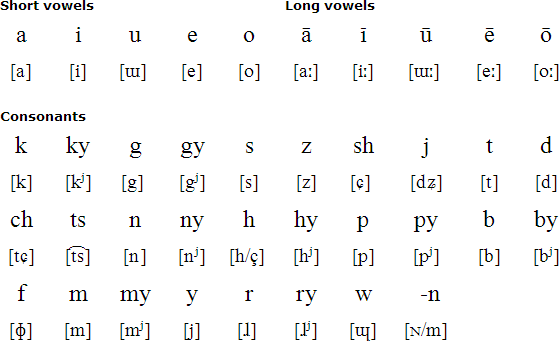
Long vowels

How long vowels are written in katakana

Pronunciation

Japanese pronunciation


петак, 8. јун 2012.

Hirangana (Japanese language, first of three letters)


Japanese Hiragana

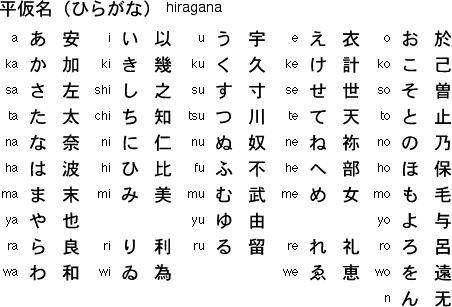
Hiragana syllables developed from Chinese characters, as shown below:


Hiragana were originally called onnade or 'women's hand' as were used mainly by women - men wrote in kanji and katakanaBy the 10th century, hiragana were used by everybody. The word hiragana means "oridinary syllabic script". The present orthography of hiragana was codified by the Japanese government in 1946.

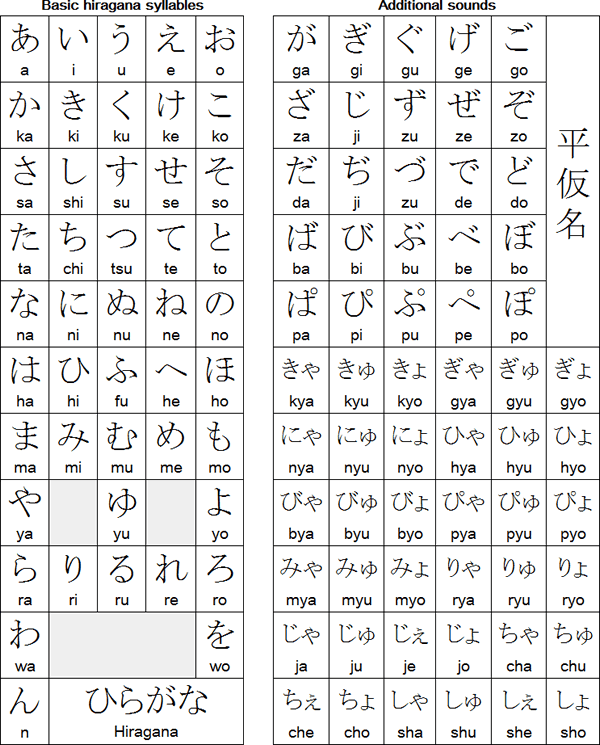
Hirgana syllabary (平仮名 / ひらがな)


The symbols on the right are the basic hiragana syllabary in the order they appear in dictionaries and indices (reading from left to right and top to bottom). Additional sounds (the symbols on the right) are represented by diacritics and combinations of symbols.

Long vowels


Characteristics and usage of hiragana

The hiragana syllabary consists of 48 syllables and is mainly used to write word endings, known as okurigana in Japanese. Hiragana are also widely used in materials for children, textbooks, animation and comic books, to write Japanese words which are not normally written with kanji, such as adverbs and some nouns and adjectives, or for words whose kanji are obscure or obselete.
Hiragana are also sometimes written above or along side kanji to indicate pronunciation, especially if the pronunication is obscure or non-standard. Hiragana used in this way are known as furigana or ruby. In horizontal texts, the furigana appear above the kanji and in vertical texts, the furigana appear on the right of the kanji. In newspapers it is a legal requirement for furigana to be attached to kanji which are not included in the official list of the 1,945 most frequently-used kanji. Newspapers in fact rarely use kanji not included in this list.

Caracteres hiragana


あ  aい  iう  uえ  eお  oゃ  yaゅ  yuょ  yo
か kaき kiく kuけ keこ koきゃ kyaきゅ kyuきょ kyo
さ saし shiす suせ seそ soしゃ shaしゅ shuしょ sho
た taち chiつ tsuて teと toちゃ chaちゅ chuちょ cho
な naに niぬ nuね neの noにゃ nyaにゅ nyuにょ nyo
は haひ hiふ fuへ heほ hoひゃ hyaひゅ hyuひょ hyo
ま maみ miむ muめ meも moみゃ myaみゅ myuみょ myo
や yaゆ yuよ yo
ら raり riる ruれ reろ roりゃ ryaりゅ ryuりょ ryo
わ waゐ wiゑ weを woゐゃ wyaゐゅ wyuゐょ wyo
ん n
が gaぎ giぐ guげ geご goぎゃ gyaぎゅ gyuぎょ gyo
ざ zaじ jiず zuぜ zeぞ zoじゃ jaじゅ juじょ jo
だ daぢ jiづ zuで deど doぢゃ jaぢゅ juぢょ jo
ば baび biぶ buべ beぼ boびゃ byaびゅ byuびょ byo
ぱ paぴ piぷ puぺ peぽ poぴゃ pyaぴゅ pyuぴょ pyo